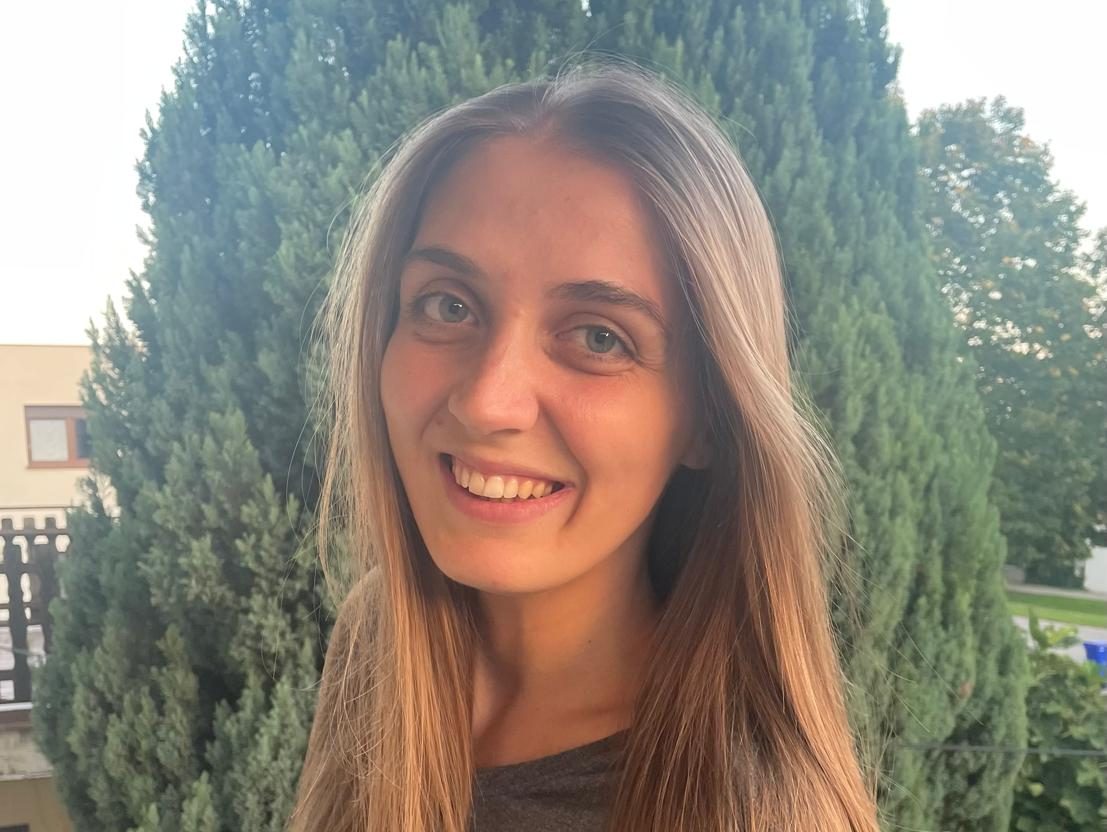
Kristína Kraljiková was SEPE International’s first international intern—from Slovakia! Read on to see how God used her two-month internship in Honduras to overcome the hurdles of language learning, shape her understanding of cross-cultural evangelism, and deepen her love for His global church.
A Desire Takes Root
When Kristina first felt a desire to go to Latin America, she had no idea where it would lead—or how God would orchestrate every detail to get her there.
“For a long time,” she says, “I’ve had a desire to come, in general, to Latin America. I didn’t have an exact preference about the country. I just really wanted to come to this part of the world.”
Her interest in Latin American culture started when she was just a teenager. During a year-long period of study in Texas as an exchange student, she developed friendships with a few Mexicans who made her feel welcome in a time when the language barrier made it hard to connect with most people.
“The [Mexican] culture is so different,” she says, “but for me, in a good way, and that’s why I wanted to get to know more of it.”
Kristina has also always had a love for languages, so the choice to learn Spanish was a natural one, especially after her study abroad experience.
“I think because of this desire that I had,” she says, “I wanted to study Spanish.”
A Door Opens
Despite her best efforts, Kristina struggled to find a credible cross-cultural opportunity. And at one point, she even gave up searching. But what seemed like a closed door was only God’s way of preparing the right one to open.
In the summer of 2024, she met a missionary family from the United States. When she mentioned her interest in Latin America, they didn’t just give a polite nod.
They connected her, leading her to get in touch with SEPE International.
“God managed everything so that I could come—with work, with many other things,” she says. “And I just could see that doors were opening.”
A Discovery in Language
Before she knew it, she was finally on Honduran soil, and what started as a one-month internship soon turned into two.
“After two weeks,” she says, “I could see that I didn’t have to have fear of not knowing enough Spanish, because [Hondurans] are so happy when people are trying to speak Spanish as their second or third language.”
Kristina quickly realized that having even an elementary grasp of the native language was crucial to forming relationships with the Honduran people.
Her extended internship gave her plenty of opportunities to do just that.
“For me, it was such a big blessing that I could spend every day in different places,” she says. “I was pushed so much to speak in Spanish, and this was the best thing at the beginning for me, even though it was so difficult because I needed to translate everything in my head. But it was such a great thing, because I could learn Spanish faster, and also get to know people faster—their culture and so on.”
A Departure from Fear to Faith
As she settled in, a few cultural differences stood out: bigger, close-knit families; open, welcoming interactions; a deep appreciation for the everyday; and an unhurried pace of life.
But most importantly, she learned important lessons about sharing the Gospel in a country different from her own.
“Over here,” she says, “some people cannot read, or they couldn’t go to school because of their family situation. And sometimes it’s necessary to think in which way to talk to the people—for example, when it comes to the Gospel.”
Understanding this aspect of the culture helped her to really think through how she proclaimed Christ to others.
“Over here,” she says, “people maybe are not that well educated. And maybe they don’t have that good a vocabulary, or they don’t understand some words. But it’s good to learn that the Gospel is simple, and we can say it in a simple way, so even children can understand it.”
Her previous experience was a very different story.
“In Europe, it’s completely the opposite,” she says. “People are educated. But it’s much more difficult to get to them, because when we are sharing the Gospel, they tend to judge a lot—Christianity in general, I would say.”
Recognizing these differences in cultures didn’t elevate one country over another, however, or grant her an excuse for favoring Gospel proclamation in one context over another.
“Over here, the obstacle is maybe education,” she says. “In Europe, people are more judging and closed, but they can understand more. So it’s the same everywhere. Every country has its pros and cons for sharing the Gospel.”
Drawing on the example of the local church leaders she served alongside, she learned to communicate the Gospel through thoughtful questions and meaningful conversations, and in the process discovered the courage to overcome her fears.
“People are lost everywhere—in every country,” she says, “and people are needy in every country, even though they don’t realize it.”
She came across a question in The Gospel & Personal Evangelism by Mark Dever that solidified her evangelistic resolve.
“The question is: The Gospel is the cure for the people who are lost,” she says. “Why do you want to keep it for yourself then?”
“I don’t want to keep the Gospel away from the people because of my fears.”
As Kristina witnessed spiritual poverty door-to-door, she also bore witness to the physical hardships these families faced, and she wrestled with the humbling reality that she could not possibly meet every need she saw.
“Sometimes I was feeling bad that I couldn’t help, in some ways, the families, but then God was teaching me that He is God, and He is taking care of all the people of this earth,” she says. “He knows everything about all the needs that people have, and that was really amazing to just rest in His sovereignty.”
A Devotion to the Great Commission
Kristina’s story reminds us that God is still calling His people to go, and He is still orchestrating the details as we respond in faith. What started as a quiet desire years ago became a living testimony of God’s global work.
“Sometimes we are living within one country, or within one church for a long period of time,” she says. “But when people go out, it’s so encouraging to see that God has His church everywhere.”
She came to learn, and she left more equipped, more grounded, and more aware of God’s heart for the nations.
“The church can be built from so many different nations, people, cultures, characters, and so on,” she says. “But God is the same, and we have the same God.”
Kristina gives God the glory for guiding her to Honduras and couldn’t be more thankful for the opportunity she had to serve there.
“I think God was keeping this desire in my heart for a long time,” she says. “I’m really glad that I could come, and it was a really great decision.”